
Sir Malcolm Rifkind recalls Margaret Thatcher’s final days in power with Bucks New University audience
What was Margaret Thatcher really like behind closed doors? Sir Malcolm Rifkind shared his memories of working alongside the former Prime Minister when he visited Bucks New University for a Q&A on Wednesday 21 October.
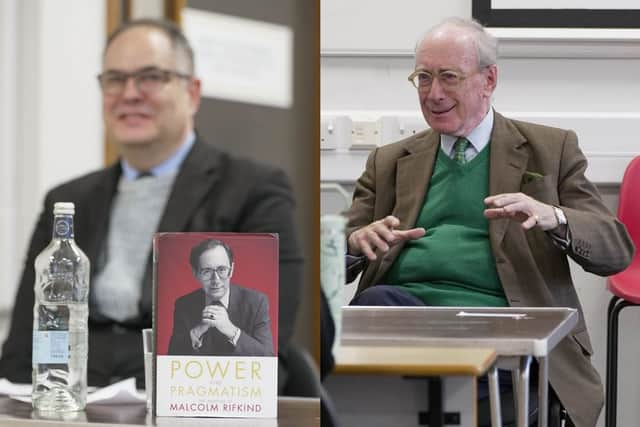

Sir Malcom, who served as Foreign Secretary and Defence Secretary during a ministerial career spanning 18 years in government, spoke about the people and events that shaped his time in Westminster, including the dramatic events leading up to Mrs Thatcher’s resignation in November 1990.
Asked about the former PM, he gave a frank assessment: “When she was good, she was excellent, but when she was bad, she was ghastly.”
He also recalled how Mrs Thatcher sought the support of Cabinet colleagues on the eve of her downfall. When she asked whether he would back her, he remembered giving a carefully worded response: he would not vote against her.
The discussion was organised by Ze’ev Portner, lecturer in Law at Bucks New University, who wanted to give staff, students and guests the chance to hear directly from someone who had been at the centre of British politics for nearly two decades.
Ze’ev said: “We read about these events in history books, but Sir Malcolm was there. It was a real opportunity to hear what happened from someone who experienced it first-hand, and to learn from his years in government and diplomacy.”
Matthew Tong, who attended the event, said Sir Malcolm's quick thinking had impressed him when watching him on television, but meeting him in person revealed a charisma he had not fully appreciated before. He said Sir Malcom's depth of knowledge and experience captivated the audience.
The conversation ranged well beyond Westminster. Sir Malcolm shared memories of a private lunch with Princess Diana in 1995, describing her as warm, compassionate and engaging. He also spoke about his support for Poland’s Solidarity movement during the final years of Communist rule, which he described as one of his proudest achievements in government.
On more recent events, he discussed the war in Ukraine and the prospects for peace in the Middle East. He stressed that diplomacy takes patience and persistence, and that progress often depends on keeping dialogue going even when a resolution seems a long way off.
He drew on examples including the end of apartheid in South Africa and the Good Friday Agreement in Northern Ireland to illustrate how peaceful outcomes can emerge when they seem unlikely.
The audience included Bucks staff and students, as well as guests from the local community and further afield. The discussion prompted plenty of interest, with several attendees saying afterwards that they could happily have listened to Sir Malcolm for two hours rather than one.
Before the Q&A, Christopher Lewis, Associate Dean (Education) for Creative Arts, Technology and Engineering at Bucks, spoke about the Aberfan disaster to mark its 60th anniversary. Those present then observed a minute’s silence in memory of the 144 people who died.