
New novel set in Aylesbury explores a shooting that took place on a train from the town heading for London in the 1930s
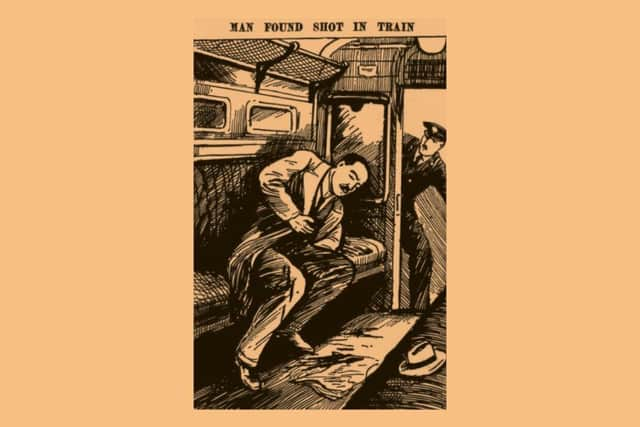
‘A Dying Declaration’ is set in and around Aylesbury and High Wycombe, is a new, self-published book which attempts to create a plausible ‘back story’ leading up to the events of 3rd February 1936 where an unfortunate shooting took place in a carriage of the 5.42 train from Aylesbury to Paddington.
Until that date, the Great Western Railway was proud to declare an unblemished record regarding its passenger safety. But that reputation was to change dramatically. A passenger, Arthur Mead, was found in a carriage fatally wounded from a gunshot.

Having received positive feedback for his first novel, ‘A Jealous Feast’, set in 1919, the author, Jonathan Wilkinson, set about looking for the inspiration for another story. He explained that he “ [I] wanted to use the theme of an unexplained murder and a setting where I could write about train travel, but fancied a change of era, perhaps the 1930’s. With that in mind, I entered the following in a search engine, ‘Murder train 1936’. The first article that appeared was from the British Transport Police website and featured the story of the first ever murder reported on the Great Western Railway under the heading ‘The strange case of Arthur Mead’.”
Attended by a doctor, a priest and the police, the passenger, Arthur Mead, managed to give a description of the man who had attacked him and the weapon. It was a dying declaration which proved to be unfounded.
The book relies heavily on the report of the Coroner’s Inquest as reported in the Bucks Herald on 21st February 1936 but the author was particularly intrigued about the reference made to a visit Mr Mead made to a Public House in Waddesdon village on the morning of his death, why he visited his friend, the owner, and why he was desperate for £25. There was no explanation given in the newspaper reports of the day.
The story was also prompted by the dying declaration made by Mr. Mead that he had been attacked by a man and shot with a revolver. This appeared to be quickly dismissed by the police with them calling off a search as soon as the gun was found on the railway track. The local newspapers quickly reported that the manhunt had been abandoned but did not explain why. “The backstory relies heavily on these and other unanswered questions I had,” said Mr Wilkinson, ”although I struggled to find any background detail or information to the case, such as we are used to seeing today. No investigative journalism around the characters, the activities, or the motivation for the crime. No background interviews with friends or neighbours. The bold facts were presented in the local newspapers in the way in which they were gathered, through attendance at the various court hearings. The Bucks Herald articles of the day covered the various court sessions and the evidence provided by witnesses to the activities leading up to, and the aftermath of, the incident.”
“My wife and I visited Waddesdon village as part of my research and called at Waddesdon Manor, a National Trust property, whilst we were in Buckinghamshire. This beautifully spectacular property was bequeathed to the National Trust in 1957, by the then owner James de Rothschild, who was a Member of Parliament and philanthropist from the wealthy Rothschild banking dynasty. I felt that it would be a colossal opportunity missed if I failed to include the house and contents in the book.”
The setting for the story is at the start of 1936. Britain is in turmoil and there’s a worrying sea change in the political make-up across Europe. The General Election in November 1935 has not managed to stabilize the fragile balance of power.
Oswald Mosley has ordered his Branch Inspectors to ensure that the local branches of the British Union of Fascists (BUF) are ready for winning power at the next general election and are resolute in propagating the Fascist cause – a crusade against Jewry.
James de Rothschild, grandson of the founder of the French branch of the Rothschild family, owner of Waddesdon Manor, and Member of Parliament for the Isle of Ely, is determined to take every opportunity to highlight the plight of his fellow Jews in Germany. An unwavering stance which puts him and his wife in grave danger.
Arthur Mead, an unemployed butcher from High Wycombe, becomes embroiled in a BUF Aylesbury Branch plot to sabotage James de Rothschild’s quest for British action against Hitler and Mussolini. He tries to extricate himself from his obligation only to find that he has nowhere to hide.
“As I was getting towards the end of the book,” said Mr Wilkinson, “I was fortunate, on the off chance, to contact Buckinghamshire County Council to ask if the Coroner’s Office had any information on Mr. Baily Gibson, the Coroner in this case. I also asked if there were any remaining records of the case, despite being advised that records are only kept for 75 years. To my surprise the witness statements and the Coroner’s record were still being held, and I was able to purchase copies. I have used the detail in these statements in the later chapters of the book to supplement the newspaper reports.”
When asked about the potential issues surrounding the self-publishing of his book, Mr Wilkinson said “ It’s not just writing the book, you also need the support of local businesses. Self-publishing your work is fraught with issues, and it’s a bonus to have the support of local professionals to guide you through the practicalities of the publishing experience. For both of my novels I have leaned on the expertise of The Book Typesetters based in Newark close to where I live in Nottinghamshire. And of course, you also need the support of a book seller with a passion for sourcing and recommending books for people, including the promotion of works of local writers. The Berkhamsted Bookshop, High Street, Berkhamsted, is keen to maintain a quality selection of books across multiple genres and is where my book, 'A Dying Declaration', is available to purchase. I’m certainly grateful that this independent book shop, with a big heart, provides a fantastic outlet for writers like me.”