
Medical student from The University of Buckingham develops award-winning app to help prevent blindness
A final-year medical student at The University of Buckingham has developed an award-winning smartphone app that could help prevent avoidable blindness in some of the world's poorest communities.
Pradipta Chowdhury led the creation of ALO, an artificial intelligence (AI)-powered app that can analyse a photograph of a person's eye and identify possible cataracts, one of the leading causes of blindness worldwide. The app's name comes from the Bengali word for ‘light’.
The idea was inspired by Pradipta's childhood volunteering at eye camps in Bangladesh, where he saw first-hand the impact of delayed treatment. Many patients arrived only after losing much of their sight, when surgery had become more complex and difficult. In Bangladesh alone, around 570,000 people are living with cataract-related blindness, despite cataracts being treatable through routine surgery. For many families, however, the cost and time involved in travelling to hospital can create significant barriers to early diagnosis and treatment.
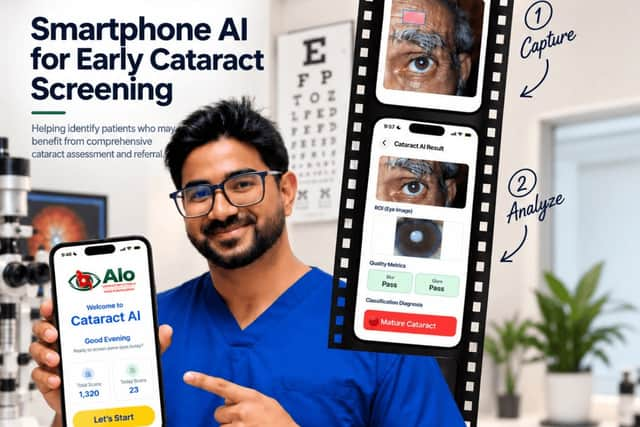

Determined to find a solution, Pradipta began developing ALO in 2024 while studying medicine at Buckingham. Working alongside Professor Prakash Kumar Chowdhury, Academic Director of Chattogram Lions Eye Institute and Hospital, he coordinated an international team responsible for the app's AI development, clinical testing and patient data collection.
The goal is simple: to bring eye screening into rural communities rather than expecting patients to travel long distances for an assessment. The free-to-use app allows local volunteers to screen residents using an ordinary smartphone. People identified as potentially having cataracts can then be examined by visiting specialists and referred for treatment where needed.
Developed while studying medicine at Buckingham, the technology has already been tested on 4,000 patients in Bangladesh, won international awards and is now set to be trialled in countries across Asia, the Middle East and Africa. Following the success of the Bangladesh trials, further pilot studies are planned in Lebanon, Bahrain, Nepal, Pakistan and Nigeria.
Pradipta said: "The inspiration for ALO came from seeing people lose their sight because they could not access care early enough. Our aim is to make eye screening available to everyone, wherever they live, using technology that is already in their hands. If we can identify cataracts earlier, we can help people access treatment sooner and prevent unnecessary blindness."
What began as an idea developed by a University of Buckingham medical student, has grown into an internationally-recognised innovation with the potential to transform eye care in underserved communities around the world.