
Aylesbury window cleaner discovers £200m Shakespeare portrait
A cleaner in Aylesbury is in possession of what he believes to be one of the rarest ever William Shakespeare portraits.
Steven Wadlow has a portrait hanging in his living room that has been authenticated as a genuine portrait of William Shakespeare.
In the painting, Shakespeare is 31, with hair and no beard, it is the only portrait painted when Shakespeare was alive.
Steven said: “One expert has suggested, if it were proven to be Shakespeare, it could be worth anything from 100 to 200 million, which is obviously worth investigating further.
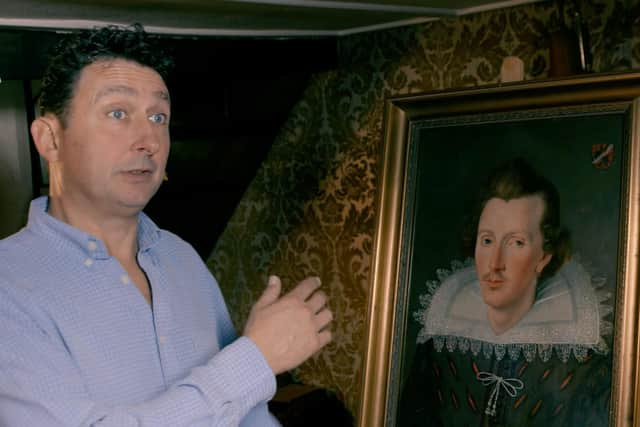

“I didn't particularly like it because it used to scare me, wherever you are in the house, it's looking at you. It always used to remind me of those portraits on Scooby Doo.”
Steven’s interest in the painting was sparked after his dad watched an episode of Time Team. Steven added: One night over 11 years ago, mum and dad were watching a programme about Stratford upon Avon when they noticed a painting with a familiar face. My dad phoned me the next day and said, I think the painting in the corner might be Shakespeare.”
A few days later a visiting English and Art lecturer confirmed these suspicions, starting a 12-year exploration into the portrait’s origins.
According to television company, Barkingmad TV, over the 12 years extensive scientific analysis at some of the world’s leading art institutions, including the Hamilton Kerr Institute and University College London, has taken place.

Cutting edge technology revealed underdrawings, including a mysterious coat of arms and overpainting that had been added in order to disguise the true identity of the sitter. At each stage Steven feared his painting could be exposed as a fake, or a later copy like so many other portraits of Shakespeare. However, Steven’s painting passed every test.
Steven’s dad bought the painting from the Great Tew Estates in Oxfordshire, in the 1960s. Today the estate near Banbury is known for its celebrity residents, including the Beckhams, Simon Cowell, Claudia Winkleman, Prince Harry and Meghan Markle.
“What I discovered was that the manor house had once been home to a portrait of Shakespeare,” Steven said.
Art experts believe that this vanished portrait of Shakespeare was used as the model for the earliest engraving of the bard which appeared on the first folio of his plays printed in 1623.
Steven’s portrait had many similarities with this missing portrait.
“Like my painting, it was oil on panel and like my painting was painted in 1595. 1595 would be very convenient, because in 1595 Shakespeare was 31. On my portrait is a 31,” he said.
Whilst Steven’s research was going well, there was one big problem, companies refused to accept a portrait of Shakespeare with hair and no beard.
Steven said: “You feel like you're banging your head against a wall or trying to get through closed doors because you're not part of the establishment.”
Another issue is a lack of concrete knowledge establishing what Shakespeare looked like. The engraving on the first folio was done seven years after he died by an engraver who never met him, historians have confirmed. Steven added: “I'm very, very sure, that our portrait was the model for the engraving. But how do we prove that?
“I suppose, if I'm being totally honest, it has become a bit of an obsession, the obsession to prove some people wrong. If I'd have known 10 years ago, we'd still be at it now, trying to find answers. Would I have begun all this? Probably not, to be honest.”
Steven has used new facial recognition technology which backed up his claims.
Lumiere technology of Paris has now taken an interest in Steven’s painting. Lumiere has handled thousands of the greatest artworks in the world including the Mona Lisa.
Jean Penicaut of Lumiere technology, who tested the painting using his company’s latest technology, believes the picture depicts Shakespeare as an actor, playing a role in one of his own plays.
“The conformity with the mouth I am 100% sure this is the same.” Said Penicaut: “For me, it really is a portrait of Shakespeare.”
Steven concluded: “That was an amazing day. After all these years and all the, is it Shakespeare? Isn't it Shakespeare? And then today we have Jean, who discovered the under drawings on the Mona Lisa, saying that our painting is Shakespeare. You just can't get better than that."