
86% of adults in the South East believe that keeping a goldfish in a bag is cruel
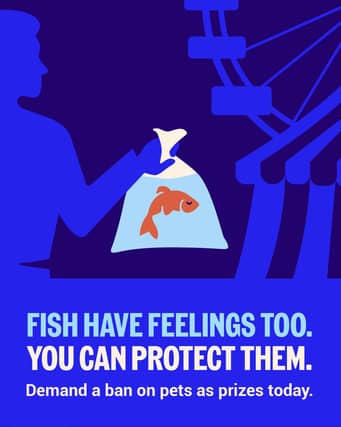

RSPCA’s #NoFunAtTheFair campaign calls for the ban of pets as prizes
New figures show 86% of adults in the South West believe that keeping a goldfish in a bag is animal cruelty - as the RSPCA calls upon councils across England to ban pets being given as prizes on their land.
This week the RSPCA relaunches its #NoFunAtTheFaircampaign calling for the outdated practice - which mostly involves goldfish being handed out as prizes - to be banned.
All of Wales’ 22 local authorities have restricted this activity on the land which they control but giving away pets as prizes remains legal on privately-owned land in Wales - as is the case in England. The charity is now urging its supporters in England to sign an email which calls upon their local authorities to stamp down on this practice to protect animals that otherwise often could suffer as a consequence of being given away.
In England, the RSPCA is aware of more than 160 councilswho have banned this practice - but the charity wants to see more sign up.
The RSPCA is ultimately calling on both the UK Government and Welsh Government to introduce outright bans on the giving of pets as prizes via national legislation - but local councils taking action is a great step in restricting the practice locally, and raising awareness about animal welfare.
New data* obtained by the RSPCA has found that:
- 76% of adults in the South East agree that local governments in England and Wales should ban the giving of pets as prizes on council-owned land.
- 88% of adults in the South Eastare shocked that pets can still legally be given away as prizes. 61% ‘very shocked’, while 27% are ‘somewhat shocked’.
- 71% of adults in the South East are not aware that pets can be given away as prizes,
- 86% of adults in the South East believe that keeping a goldfish in a bag is animal cruelty.
- 75% of adults in the South East agree that the UK and Welsh governments should ban the giving of pets as prizes on private-owned land.
Goldfish are the animal most commonly associated with prize-giving. Over the past few years (since 2020), there have been 53 reports (involving 400 animals) about pets being given as prizes made to the RSPCA; but the charity fears many incidents go unreported.
RSPCA Campaigns Officer Christa Harwood said: “Our list of councils across England is ever-growing but we’re now calling on our supporters across the South East to help us call on their local council to take this important action and ban this practice on their land.
“There is clearly strong public support for councils to take action - but we still need your help to get the message out there. The more people who sign our action, the more councillors will get the message that a ban is needed - and wanted.
“Please help make a difference for animals and help us spread the word and take our supporter action to ban this outdated practice from your local area.”
The RSPCA believes animal ownership is a big responsibility, and while goldfish can make great companions, they shouldn't be acquired via a spur-of-the-moment game.
Goldfish are easily stressed and very often fish that are won as prizes suffer miserably from shock, oxygen starvation or die from changes in water temperature, while many may die before their new owners can get them home.
The RSPCA is also concerned that giving pets away as prizes risks further damaging how animals are perceived by society.
Evie Button, RSPCA animal welfare expert, said: “We all want to see a world where pets are acquired responsibly, well looked after and respected. But sadly, many goldfish are at risk with their welfare hinging on the spur-of-the-moment result of a carnival game.
“Goldfish are easily stressed and often, fish won as prizes suffer miserably from shock, oxygen starvation or die from changes in water temperature, and many will die before their new owners even get them home. They're misunderstood pets - as they can make great companions; but can be challenging to look after and owners must do their research before they acquire the fish, not afterwards.
“Handing someone a sentient animal in a plastic bag full of water as a prize can clearly encourage individuals to not treat them as a sentient being, but rather as a worthless object that can be thrown away.
“Put simply, animals are not prizes. As we all strive to create a better and kinder world for every animal, the best way to keep goldfish safe and end this outdated spectre is to encourage all councils to take action and ban pets as prizes to inspire the UK and Welsh Governments to introduce outright bans - as is already the case in Scotland.”
- **Savanta interviewed 2,270 UK adults aged 18+ online between 16th and 19th May 2025. The sample included 1,779 respondents in England, and 324 respondents in Wales. Data was weighted to be representative of the UK by age, sex, region, and social grade.
- Images can be downloaded here
- The RSPCA is aware of 166 councils in England who have banned this practice - download the list here
- Under the Animal Welfare Act 2006, it is an offence to enter into an arrangement with a person reasonably believed to be under 16, who is not accompanied by an adult, whereby an animal is to be won as a prize.
- In Scotland it's an offence in almost all circumstances to give an animal away as a prize to anyone regardless of age.
- The full link to support this campaign is: https://www.rspca.org.uk/getinvolved/campaign/petprizes
Know what your goldfish needs:
- Goldfish can grow very large (around 20 cm long for fancy varieties and 30cm long for larger breeds) and are long-lived (up to around 30 years). We recommend that young goldfish are kept in at least 60 litres of water per fish, with adults needing more space.
- Make sure you know what space, depth and surface area of water is needed for the number and size of your fish and find out how to acclimate your fish to their new home. Find out about what food, how often and how much your fish will eat. Avoid overfeeding by giving food little and often.
- Include plants to promote the growth of aquatic animals for extra food, provide shade and release oxygen in the water for the fish.
- Find out which types of fish can live together - double-tailed goldfish are not able to swim as quickly as single-tailed fish so may miss out on food if housed with the single-tailed varieties.
- New fish should be housed separately to your other fish for a short period of time so they don’t spread disease.
- Get to know your goldfish to help spot signs of something being wrong with the aquarium or the fish being sick or injured – if in doubt, ask your vet and experienced fish keepers for advice.