
Huge new M25 service station approved in Buckinghamshire including food court and retail space
Plans for a huge motorway service area near Chalfont St Peter on the M25 have been approved, almost three years after councillors resolved to reject the development.
Buckinghamshire Council’s Strategic Sites Committee backed Extra MSA Group’s proposals for land between junctions 16 and 17 of the M25.
The outline application includes a two-storey facilities building containing a food court, retail space, business facilities, toilets and washing facilities.
Plans also include a filling station with 24 pumps, up to 759 spaces for cars and other light vehicles, 190 HGV spaces, 19 coach bays and parking for caravans, motorcycles and abnormal loads.
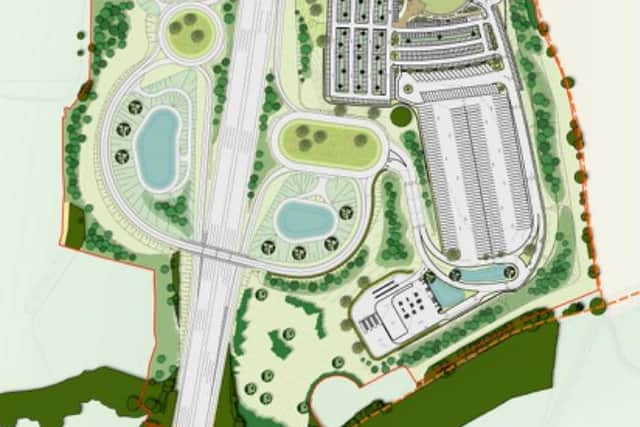

The development would also feature electric-vehicle charging points, landscaping and drainage infrastructure. Councillors resolved to refuse the application in September 2023 because of its effects on the Green Belt, open countryside and landscape, as well as concerns over flood risk.
However, the application returned to the committee following the passage of time and changes to national planning policy. The site remains designated as Green Belt, but planning officers concluded that it now met the Government’s definition of “grey belt” land.
Rachel Marber, the council’s strategic technical lead, told the committee: “The application is being called to committee by the two ward members, and it has also been referred back since it was last heard in September 2023, just because of the passage of time and changes in policy considerations.
“In terms of planning constraints, the site is designated Green Belt but considered grey belt, as set out within the report.” However, Cllr Karen Dickson, independent member for Chalfont St Peter, objected on behalf of residents and the parish council.
She said: “A major commercial complex with a filling station, extensive parking for cars, coaches and heavy goods vehicles, and 24-hour lighting and noise will permanently and irreversibly damage the landscape, the tranquillity, the biodiversity and the character of these parts of Buckinghamshire.
“It will blight the lives of thousands of our residents with associated noise and light pollution. This is not a small rural development. This application to develop a motorway service station on our Green Belt has come before and it keeps being rejected.”
Cllr Isobel Darby, Conservative member for Chalfont St Peter, quoted one of the previous reasons for refusing the development, which said it would intrude into the open countryside and fundamentally alter its character and appearance.
She added: “In short, a blot on the landscape—and this has not changed. You will have seen the HS2 activity when you visited and also on the slides today, but please imagine the end of these works with a remediated landscape.
“Enough is enough. I urge this committee to be brave, stand up for our county and refuse this application. I’m afraid I treat the name grey belt with a little bit of a pinch of salt, because it just seems a convenient way of removing land from the Green Belt which we all hold so dear and precious.”
Linda Smith, representing Chalfont St Peter Parish Council, said the area formed part of the Metropolitan Green Belt, established as a buffer around London in 1938.
She said: “This is open countryside with agricultural land and a haven for wildlife. This will be a huge structure in this landscape with noise, traffic movements and lighting, open 24/7 all year round. We shouldn’t be surrendering our Green Belt land.”
A statement from Colne Valley Regional Park warned that the cumulative impact of major developments threatened “the very existence of the park”.
However, Sebastian Tibenham, the applicant’s agent, said motorway service areas were important pieces of transport infrastructure that provided rest and parking facilities. He said: “The need here is acute. Regarding site-specific issues, the site is deemed grey belt by your appointed consultants and your officers.
“The land is already heavily disturbed by HS2 works, contains other urbanising features including large electricity pylons and is well contained by the motorway and HS2 line in physical terms.”
Mr Tibenham acknowledged the loss of agricultural land and some localised landscape harm but said these effects did not outweigh the scheme’s benefits.
The applicant estimates that the development would create approximately 674 jobs during its two-year construction and 244 jobs once operational.
Cllr Mark Roberts said he sympathised with objections concerning the loss of countryside but believed the committee had to apply the Government’s current planning rules.
He said: “Regardless of what we think about the open countryside, applying those rules is our role here. I’m satisfied that we’ve tested those rules today and that it meets the grey-belt definitions that we’ve explored.”
Cllr David Moore said he “reluctantly” supported the application but called for robust requirements covering waste and litter collection, including CCTV and coverage of the slip roads.
Cllr Gregory Smith said it was “hugely disappointing” that several acres of farmland would be covered with tarmac without solar panels being installed across the parking area.
The committee agreed to approve the application subject to the completion of a Section 106 legal agreement and planning conditions, including strengthened requirements for an operational waste and litter-management plan.